Tuesday, June 8, 2010

Movie Review: The Human Centipede (First Sequence)

Promotional poster for The Human Centipede (Fi...Image via Wikipedia
When The Human Centipede by Tom Six was first recommended to me, I was sure that it was a joke. "No, really. What's it about?" It is the kind of plot that is almost too ridiculous to comprehend. Can you really make an entire film around... that?

Yes, you can. Of course, just because you CAN do something, doesn't mean that you SHOULD. But they did anyway, and the result is one of the most grotesquely hilarious films I have seen in years.

There is no denying that this is a bad movie. This is the kind of movie that serves as the poster child for trash cinema. The next time some politician or infotainment host decides to raise the battle cry against the disgusting horror films corrupting America's youth, they will no doubt be waving around the DVD case of The Human Centipede as they scream for strict censorship laws. I don't even think I'll blame them when they do: this is not the kind of film you watch if you aren't into these kinds of films. This isn't even the kind of film that you admit to being into. I hate to throw the phrase "guilty pleasure" around with reckless abandon, but in the case of The Human Centipede, I think it is more than justified. This film is the dirty little secret you only admit watching and enjoying to those sick, twisted individuals that share your bizarre taste in cinema.

The plot is incomprehensible as it is simple. Doctor Heiter is a medical professional with a burning passion for experimental surgery, a very unpleasant bedside manner, and a skull way to large for the rest of his head. Famous for successfully separating conjoined and Siamese twins, the good doctor is now obsessed with joining things together. Heartbroken from the death of his freshly-joined three dobermans (his "Beloved Three-Dog), Heiter desides to step things up a notch and join three humans. This becomes possible when two teenage twits on a European vacation get a flat tire and stumble upon the anal-retentive (in more ways than one) mad doctor. They are the perfect victims: it is hard to feel much sympathy when the girls stumble upon a creepy German doctor with a bulging cranium and pictures of deformed fetuses on the walls, then gladly accet when he tells them to sit and offers them drinks. Two glasses of Rohypnol water and one dart-gunned Japanese drifter later, and all of the ingredients for a Human Centipede are ready and waiting. Let the good times roll.

How does he join them? I thought you 'd never ask. His brainstorm involves crippling the knees so the three can't stand up, and then surgically connecting all three people ass-to-mouth, creating a conjoined monstrosity with one continuous gastronomic passageway. That's probably the nicest way to put it. If you are having a hard time grasping the concept, fear not; the good doctor explains it all in great detail to his helpless victims, including visual aids shown on an overhead projector. Personally, I thought he would have done a better job with a PowerPoint presentation.

If this sounds like a spoiler, it really isn't. The revelation of this creation doesn't mark a climactic ending, but merely kicks off the second act. Your reaction will probably be like mine; a quick glance at a watch, followed by the dim realization that there is still an hour of this to go. This is where the film pays off, as we get to watch Heiter actually interacting with his new creation with the mixed emotions of affection and frustration you would expect from a new pet owner with irrational expectations and a monstrously skin-stretching skull. I'm not kidding, his head is huge. It actually distracts from the Human Centipede. Dieter Laser, the man behind the freakish head, makes the movie. His emotional outbursts, creepy delivery and crazed expressions  never fail to delight, and there isn't a moment that you don't believe in the character. When Dr. Heiter actually weeped at the unveiling of his creation, I couldn't help get a little teary-eyed myself. My favorite part is when he takes the Human Centipede out on the lawn for training. I'm sure it will be yours as well.

The genius behind The Human Centipede is that it is not overly graphic. You'll probably see more blood and gore on an episode of Grey's Anatomy, speaking of abominations of nature. What sets this film apart is the human cruelty and anguish of the mad doctor's victims, who are quite conscious and alert throughout the entire film, even if only one of them is able to speak after the first act. The film isn't shocking as much as it is disturbing, and it gets even more disturbing when you find yourself laughing at it. Yes, this is the kind of film that actually makes you feel dirty for watching. That's what horror films used to feel like. I kinda enjoy that.

This is not the kind of film that many will feel comfortable recommending to friends or family members, but just remember, it is all in the interest of science! Plus, The Human Centipede is also a great educational experience for the young ones; before your family viewing, quiz your children as to which part of the Human Centipede they would prefer being. After the film, compare their choices with the inherent realities displayed throughout the story. This is not only a great example of critical thought, but also teaches the lesson of being careful what you wish for.

Speaking of Careful Wishes, I should probably point out that a sequel, The Human Centipede (The Full Sequence) is due out next year.
Reblog this post [with Zemanta]

Thursday, June 3, 2010

Guest Review - The Wolfman (2010)

Lon Chaney, Jr. in Frankenstein Meets the Wolf ManImage via Wikipedia
THE WOLFMAN (2010) on DVD Review
by friend of MovieSucktastic Don Smith


In the 1941 movie THE WOLF MAN, Lon Chaney, Jr. stood out as an original creature in Universal Studio’s Monster Movie pantheon. He went toe-to-toe with the likes of Frankenstein’s monster and Dracula, two characters that have long been in the public psyche thanks to their respected books by Mary Shelley and Bram Stoker.

Chaney’s continuous, almost overbearing, pathos was heart-wrenching. All they had to do was put him in full make up & hair and say, “Lon, go do you best impression of a german shepherd!” and he stole the show.

However, the 1941 film had two glaring problems:

First, the werewolf that bit Lawrence Talbot (Chaney) was an actual trained wolf (supposedly Bela Lugosi in animal form). The question then arises, “Why didn’t Talbot turn into that style of wolf?”

If he had, the movie would not have had the longevity it still does today.

Second, anytime the wolf-man would attack some poor schmoe wandering the moors on a full moon at one in the morning, the victim looked as if he only had ketchup spread about the mouth and forehead.

The other characters stood around and would breathlessly say, “That looks ghastly!”

No it didn’t.

It looked like some poor schmoe who had been wandering the moors on a full moon at one in the morning with ketchup spread about the mouth and forehead.

But still, the 1941 movie THE WOLF MAN was a fun, fun movie.

Fast forward to 2010 and Benicio Del Toro’s version of THE WOLFMAN (note the lack of space in the title) hits the theaters. It cleared up the two biggest problems from the first.

Del Toro’s version of Talbot was attacked by a similar wolf-man and thus turning Del Toro into a wolf-man.

Also, the gore was just fun and awesome.

If a person were to turn into a six to seven foot tall grizzly bear-like thing and attacked friends and neighbors, it would not be pretty.

Go ask Timothy Treadwell.

This is not a perfect movie. Anthony Hopkins, who plays Talbot’s crazy father, is not allowed to shine as much as he could have (but in his brief scenes he does). Same thing with Hugo Weaving. Weaving, who was phenomenal in V FOR VENDETTA, is more or less window dressing in this film.

The relationship between Del Toro and Gwen (Emily Blunt) is forced and Del Toro’s acting is straight out of Keanu “Whoa!” Reeves’ book.

But where director Joe Johnston succeeded was in bringing back the “wolfman” style werewolf into fashion. For years, the werewolf movie genre had been dominated by the “dog-headed man” (see any of the UNDERWORLD movies, VAN HELSING or the even underrated and awesome DOG SOLDIERS).

Johnston created a wonderful atmosphere of late 19th century England that could easily rival (my other favorite film of the last year) SHERLOCK HOLMES.

Considering this movie had its flaws, Johnston did direct THE ROCKETEER, OCTOBER SKY and the underrated JURASSIC PARK III, so I am looking forward to his CAPTAIN AMERICA.

THE WOLFMAN was just good old fashioned Hollywood monster movie fun. After having seen it in the theater, it was why I went out and bought it the first day it was available on DVD.

So should you.

Arrrrooooooooo!
Reblog this post [with Zemanta]

Tuesday, June 1, 2010

Guillermo del Toro Drops Hobbits

Guillermo del Toro noted that John Howe's illu...Image via Wikipedia

While there is no doubt that MGM's current financial difficulties are a leading reason for the delays, you have to wonder if the recent track records of Peter Jackson and Guillermo del Toro are also responsible for giving the studio heads reason to pause the massive production of the two-part film adaptation of The Hobbit.

Not nearly enough people hated Jackson's King Kong remake as much as I did, but his adaptation of The Lovely Bones failed to gain any real audience acclaim, even among fans of the book, and was one of the less successful Oscar nominated films of the past year. Guillermo, on the other hand, continues to please art-house theater crowds, yet continually fails to bring in major receipts or reviews on his wide-release box office fair.

Add all of this to the tepid turnout for the latest batch of CGI epics to hit the theaters this year, and it is looking more and more likely that MGM just doesn't trust Jackson and del Toro to deliver any major box office cash on the backs of J.R.R Tolkien's Hobbits.

Read the Article at HuffingtonPost
Reblog this post [with Zemanta]

Thursday, May 6, 2010

Right Wing Movie Review: How to Train Your Dragon, Anti-American Pro-Terrorist Propaganda

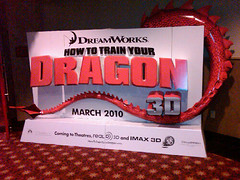
How To Train Your Dragon Movie Theater StandeeImage by christianz1969 via Flickr
This Right Wing Movie Review has been brought to you by the letters G, O and P, your local Tea Party organizers, and by GoldLine, because there’s nothing more patriotic than speculating on America’s eventual financial ruin. 

How to Train Your Dragon, the latest box office success to come out of Dreamworks, is probably the most blatant and chilling example of the indoctrination of America’s youth by the liberal elitist Hollywood since Happy Feet. Only this time, they are not using gay penguins to brainwash our children. No, this time they are using fire-breathing dragons. Or maybe I should say wolves in dragon’s clothing, because we are not really dealing with dragons here. The dragons in this animated feature are actually meant to represent Middle Eastern terrorists, and this film’s overall goal is to convince the young, impressionable minds watching it that they should be sympathetic towards those who would seek to destroy our American way of life.

Now, I know many of you are probably shocked by this accusation. After all, it is just a harmless kid’s film, right? Right, that’s what everyone thought about Pokemon before parents across the country discovered that Pikachu and Squirdle were teaching their children how to gamble and glorifying barbaric animal arena events like dog pits and cockfights.

So, in the interest of saving your children from this psychological intrusion by other malevolent parties, I am going to break the film down here and point out the subversive symbolism. There might be some spoilers here, so if you are concerned that I am going to ruin the ending of a children’s cartoon for you, you probably have bigger emotional problems to deal with.

Take, for example, the film’s opening, which introduces the home country of the film’s leading character Hiccup, the Viking village of Berk. Hiccup’s people are Norse Vikings, and the opening sequence finds them under attack constant attack by dragons. Right off, it is obvious that this Norse village is representative of white Anglo-Saxon America of European origins. I mean, if you want to have a fantasy setting that symbolizes white America, you cannot get any whiter than a Nordic warrior tribe.

This village is under attack by dragons, which are obviously meant to represent Middle Eastern terrorists. Now, you might by saying, hey, that is quite a stretch! What gave you such a far-fetched idea? Let me spell it out for you by pointing to a specific detail during the opening. As these dragons are attacking the village, the most powerful of these dragons, the dreaded Night Fury, which attacks by achieving supersonic speeds and flying into objects in order to destroy them, does so during a spectacular moment during the dragon attack by flying through one of the Viking village’s towers.

Let me repeat that for clarity: he attacks them by flying through their tower, and in an apparent kamikaze attack, otherwise known as a suicide attack. Now, can you think of another moment in our recent history that involved a suicide attacker flying into a tower? Maybe twin towers? This is an obvious allusion to the attacks of September 11, and sets the major groundwork for this film’s attempts to convince the young children watching this film that the terrorists that would do something like that are not bad people, but simply misunderstood creatures.

As they say, It is all downhill from here. The film spends a great deal of time portraying the Viking warriors, who spend all of their time battling the dragons and training their children to battle the dragons, as ignorant paranoid warmongers. Sending their children into battle is a major theme of the movie, as this has been a major argument against the wars in Iraq and Afghanistan, the idea of sending other people’s children into combat. So of course, the film features multiple scenes of children wielding weapons and being thrown into dangerous battle situations, no doubt a scary thought for any parent accompanying their children to the movie theater.

This warmongering Nordic tribe is under constant attack by these strange foreign creatures, which keep blowing up their buildings before disappearing overseas. Does this sound familiar? In addition, these monsters are coming from some mysterious place that the Vikings cannot seem to find, kind of like the nomadic Al-Qaeda tribes that keep moving from one cave to another so they cannot be tracked. It does not take a great leap of faith to make the connection.

But wait, it gets better. The hero of our story, the young pacifist Viking Hiccup, does not think we should by fighting the dragons. No, the dragons are not bad. They are just misunderstood. If we only get to know them better and learn what they like and why they are attacking us, then we can easily convince them not to. This is the philosophy proposed by the film, the whole touchy-feely approach to global conflict involving the diplomatic strategy of talking out our problems rationally with those who seem determined to destroy our homes and cripple our economy by burning fields and stealing livestock (a possible metaphor for oil). This is portrayed as the only rational solution to stopping repeated attacks against a country under direct attack.

There’s a telling bit a dialog, which I believe it’s even in the trailers, when hiccup’s father (the head Viking warrior, of course) finds out about his son’s ludicrous idea of trying to talk rationally with the monsters attacking them with incendiary weapons (WMDs? Weapons of Massive Dragons?). The father yells at the child incredulously that the dragons have killed hundreds of their people, and hiccup rebelliously responds “And we’ve killed thousands of them!” This is an obvious reference to the high death toll exacted by American troops throughout the Iraq and Afghanistan wars, and most likely a specific reference to the unfortunate loss of civilian lives at the hands of American soldiers and private war contractors. These accidental deaths are indeed tragic, no one would dare argue otherwise. However, in the logic this film expects our children to buy into, the sad reality of innocent lives being lost in necessary combat situations somehow makes us the unreasonable and more barbaric side in the conflict.

Are you starting to see the lengths that this film is going to in order to brainwash American children against the current war against subversive American-hating terroristgroups? Of course, the children in the film swoop in and save the day in the end, using the dragons (i.e. their new terrorist allies) to defeat the cause of all of this senseless fighting, the big bad dragon forcing all of the other poor dragons to do all of those bad things that have caused us to misunderstand them.

Now, whom does this big bad dragon at the end symbolize? Saddam Hussein? Osama bin Laden? Mahmoud Ahmadinejad? These are all possible candidates, but knowing how the liberal elite in Hollywood think, this monstrous Deus Ex Machina probably symbolizes something more abstract and touchy-feely, like Intolerance or Bad Karma. Whatever it represents, all it takes is its destruction for the Vikings/Americans to live in perfect peace and harmony with the Dragons/Middle Eastern Terrorists. If this sounds like a logical series of events that translates well into the real world, and you are willing to buy into this pacifist make-love-not-war view of global conflicts, than I have a Health Care Plan I would like to sell you. Let’s just hope our future generations adopt this approach to battling the real fire-breathing dragons of the world.

This satirical film review was originally recorded in Episode #15 of the film review podcast MovieSucktastic.

Reblog this post [with Zemanta]

Monday, May 3, 2010

How to Train Your Dragon and Avatar Abductions!

If you haven't tuned in to the MovieSucktastic podcast lately, you might want to check out the latest episode. There have been a lot of changes to the show format in the past few months, but the latest change was something that nobody could have predicted. It turns out that MovieSucktastic co-host Joey has been abducted by what appears to be a militant faction of Avatar fanatics. While no responsibility has been claimed and no demands or intentions have been made, the audio of Joey's last known phone message on his way to record the latest episode (he never arrived) is damning evidence in itself that these Avatar-obsessed hooligans have taken Joey hostage in retaliation for past anti-Avatar reviews posted by his fellow MovieSucktastic co-host, Scott Wilson.

With Joey's fate uncertain, Scott does his best to keep the show going, promising to keep the audience updated on the situation. In the meantime, Scott takes the time to go over the success of A Nightmare on Elm Street in the weekend box office results, shamelessly promotes his book (Monster Rally, available on Amazon.com), and channels the spiritual energy of Glenn Beck for a very special Right-Wing Review of the pro-terrorist anti-American animated feature How to Train Your Dragon.

You're going to regret it if you don't keep up with the latest happenings at MovieSucktastic, either at iTunes, Podcast Alley, Podcast.com or MovieSucktastic.com. Because this summer, things are going to Suck a whole lot more.
Reblog this post [with Zemanta]

Thursday, April 29, 2010

Bad Movie Alert: Survival of the Dead

Thought Land of the Dead was just plain painful? Felt Diary of the Dead was even worse? Brother, you ain't seen nothing yet. Strap yourselves in for yet another stop on the George Romero's "They Just Keep Giving Me Money" tour with the potentially atrocious Survival of the Dead:


That's right, not only is Romero still writing and directing these hollow attempts at clinging to relevance, he's able to talk Apple into product placement. Apparently, iPhones will somehow survive the undead apocalypse.
Reblog this post [with Zemanta]

Monday, April 26, 2010

Bad Movie Review: The Keep (1983)

I have never been a huge fan of Michael Mann. His crime dramas have always been too serious and self absorbed for my taste, and he seems to think that eliciting deadpan, monotone performances out of his actors somehow amplifies the dramatic tension and suspense he so desperately desires. While I remain a huge fan to this day of the original Manhunter, the fact that Mann’s penchant for stylistic brooding and emotionless emoting actually worked in the film’s favor is nothing more than a happy accident. Moreover, if Manhunter is a testament to how his filmmaking style can occasionally get it right, then The Keep is the perfect example of how his directorial visions can go so very, very wrong.

The 1983 film The Keep is an adaptation of the 1981 F. Paul Wilson book of the same name. The book was the first of the Adversary Cycle, and if you know what that means, then you have probably already read the book. You might have never seen the film, however, as it mysteriously dropped off the face of the earth after its brief theatrical run and initial release on VHS. Then again, it probably isn’t that much of a mystery when you consider that it came in #13 when it opened the weekend before Christmas (not exactly the time of year I would have chosen to release a horror film with Nazis) to dismal reviews like “The Keep: You Can Keep It.” It went on to earn less than five million in its brief run, which was a disappointing number even back then.

Ironically, the film starts off quite promisingly. The first half hour has the slow, foreboding pace of a European art-house war film, with plenty of slow motion shots of advancing Nazi trucks and long, expansive wide shots of the monolithic Keep around which the film’s action centers. Measured, deliberate dialogue and camera angles alternating between claustrophobic and agoraphobic slowly build a tense feeling of anticipation, which is successfully amplified by the anachronistic but still surprisingly appropriate Tangerine Dream synth-pop score. As the film sets things in motion, and the Third Reich continuously ignores the ominous warnings of the Romanian villagers to avoid the Keep, it becomes more and more apparent that the stone corridors will soon be littered with Nazi corpses. Then, as two greedy soldiers pry up one of the many nickel crosses embedded in the stone walls, the audience is gleefully rewarded with its first gruesomely dismembered Nazi, as the evil force contained with The Keep is finally unleashed.

Unfortunately, this is when it all starts to fall apart. Things start to get sketchy with the introduction of Scott Glen’s character, Glaeken Trismegestus (spelled like it sounds, apparently), who spends half of the film wandering the countryside avoiding facial expressions and occasionally mesmerizing random people with his glowing eyes. The fact that the white-light eye effect looks remarkably similar to the reflecting-eyes dream sequences in Manhunter cannot be ignored. It gets worse when Ian McKellen’s Dr. Cuza is rushed in from a nearby concentration camp to decipher some wall etchings. McKellen is usually great, but he seems to be a bit off his game in this one. It does not help matters that as his crippled elderly character grows healthier and younger with the aid of the evil force’s influences, he starts to look more and more like an albino Julian Sands.

It’s not that the performances are bad, so much as that they are simply prevented from being good. Jürgen Prochnow manages to steal the show as the sympathetic Nazi Captain Woermann, mostly due to his ability to skirt Mann’s “No Emotions on Set” rule by playing his low-key intensity to great effect. Other than him, however, everyone is overpowered by the general blandness that overtakes the film’s tension by the halfway mark. Even Gabriel Byrne, who usually hands in an excellent performance, divides his screen time between playing it straight-faced for Mann and doing his best to distract the audience from the worst Nazi haircut you’ve ever seen. There is very little characterization, and even less plot advancement, apart from the occasional mention of more dead Nazis. By the time Dr. Cuza’s protective daughter instantly jumps into bed with glowing-eyed stranger with the unpronounceable name, it is painfully aware that the audience is being forcefully shoved towards a hasty and ill-conceived ending.

For me, the final straw was just before the film’s climax, when Gabriel Byrnes’ character screams like a little girl upon stumbling across the charred remains of his platoon. Because, really, what are the odds that a Nazi Major has ever seen charred corpses before, right? But little annoyances like that are eclipsed by the big reveal of the film’s monster, which turns out to be nothing more than a wasp-waisted cross between Darkseid, Swamp Thing, and the Snake Head creature from Dreamscape. The big finale, which involves numerous overly melodramatic self-sacrifices and an amazingly underwhelming laser battle (don’t ask), is more befuddling and annoying than anything else. It all leaves you staring at a freeze-frame of Alberta Watson’s wind-swept hair and wondering what exactly happened during the last twenty minutes.

As is the case with most cinematic disasters, few are willing to take the blame for this one. Michael Mann, whose name was attached to this colossal dud as writer/director, likes to blame the studios for cutting his three-hour vision of the book into an industry-friendly ninety minutes. F. Paul Wilson, who had access to early drafts of Mann’s screenplay and whose advise and comments on it were soundly ignored, prefers to blame the arrogance of the writer/director that was more concerned with making the film his own than he was with making it good. Having read the book years ago, I tend to side with Wilson. In short… get ready for the pun… The Keep is far from a keeper.
Reblog this post [with Zemanta]