Thursday, May 6, 2010

Right Wing Movie Review: How to Train Your Dragon, Anti-American Pro-Terrorist Propaganda

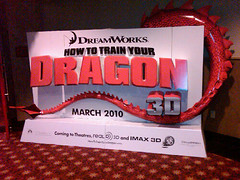
How To Train Your Dragon Movie Theater StandeeImage by christianz1969 via Flickr
This Right Wing Movie Review has been brought to you by the letters G, O and P, your local Tea Party organizers, and by GoldLine, because there’s nothing more patriotic than speculating on America’s eventual financial ruin. 

How to Train Your Dragon, the latest box office success to come out of Dreamworks, is probably the most blatant and chilling example of the indoctrination of America’s youth by the liberal elitist Hollywood since Happy Feet. Only this time, they are not using gay penguins to brainwash our children. No, this time they are using fire-breathing dragons. Or maybe I should say wolves in dragon’s clothing, because we are not really dealing with dragons here. The dragons in this animated feature are actually meant to represent Middle Eastern terrorists, and this film’s overall goal is to convince the young, impressionable minds watching it that they should be sympathetic towards those who would seek to destroy our American way of life.

Now, I know many of you are probably shocked by this accusation. After all, it is just a harmless kid’s film, right? Right, that’s what everyone thought about Pokemon before parents across the country discovered that Pikachu and Squirdle were teaching their children how to gamble and glorifying barbaric animal arena events like dog pits and cockfights.

So, in the interest of saving your children from this psychological intrusion by other malevolent parties, I am going to break the film down here and point out the subversive symbolism. There might be some spoilers here, so if you are concerned that I am going to ruin the ending of a children’s cartoon for you, you probably have bigger emotional problems to deal with.

Take, for example, the film’s opening, which introduces the home country of the film’s leading character Hiccup, the Viking village of Berk. Hiccup’s people are Norse Vikings, and the opening sequence finds them under attack constant attack by dragons. Right off, it is obvious that this Norse village is representative of white Anglo-Saxon America of European origins. I mean, if you want to have a fantasy setting that symbolizes white America, you cannot get any whiter than a Nordic warrior tribe.

This village is under attack by dragons, which are obviously meant to represent Middle Eastern terrorists. Now, you might by saying, hey, that is quite a stretch! What gave you such a far-fetched idea? Let me spell it out for you by pointing to a specific detail during the opening. As these dragons are attacking the village, the most powerful of these dragons, the dreaded Night Fury, which attacks by achieving supersonic speeds and flying into objects in order to destroy them, does so during a spectacular moment during the dragon attack by flying through one of the Viking village’s towers.

Let me repeat that for clarity: he attacks them by flying through their tower, and in an apparent kamikaze attack, otherwise known as a suicide attack. Now, can you think of another moment in our recent history that involved a suicide attacker flying into a tower? Maybe twin towers? This is an obvious allusion to the attacks of September 11, and sets the major groundwork for this film’s attempts to convince the young children watching this film that the terrorists that would do something like that are not bad people, but simply misunderstood creatures.

As they say, It is all downhill from here. The film spends a great deal of time portraying the Viking warriors, who spend all of their time battling the dragons and training their children to battle the dragons, as ignorant paranoid warmongers. Sending their children into battle is a major theme of the movie, as this has been a major argument against the wars in Iraq and Afghanistan, the idea of sending other people’s children into combat. So of course, the film features multiple scenes of children wielding weapons and being thrown into dangerous battle situations, no doubt a scary thought for any parent accompanying their children to the movie theater.

This warmongering Nordic tribe is under constant attack by these strange foreign creatures, which keep blowing up their buildings before disappearing overseas. Does this sound familiar? In addition, these monsters are coming from some mysterious place that the Vikings cannot seem to find, kind of like the nomadic Al-Qaeda tribes that keep moving from one cave to another so they cannot be tracked. It does not take a great leap of faith to make the connection.

But wait, it gets better. The hero of our story, the young pacifist Viking Hiccup, does not think we should by fighting the dragons. No, the dragons are not bad. They are just misunderstood. If we only get to know them better and learn what they like and why they are attacking us, then we can easily convince them not to. This is the philosophy proposed by the film, the whole touchy-feely approach to global conflict involving the diplomatic strategy of talking out our problems rationally with those who seem determined to destroy our homes and cripple our economy by burning fields and stealing livestock (a possible metaphor for oil). This is portrayed as the only rational solution to stopping repeated attacks against a country under direct attack.

There’s a telling bit a dialog, which I believe it’s even in the trailers, when hiccup’s father (the head Viking warrior, of course) finds out about his son’s ludicrous idea of trying to talk rationally with the monsters attacking them with incendiary weapons (WMDs? Weapons of Massive Dragons?). The father yells at the child incredulously that the dragons have killed hundreds of their people, and hiccup rebelliously responds “And we’ve killed thousands of them!” This is an obvious reference to the high death toll exacted by American troops throughout the Iraq and Afghanistan wars, and most likely a specific reference to the unfortunate loss of civilian lives at the hands of American soldiers and private war contractors. These accidental deaths are indeed tragic, no one would dare argue otherwise. However, in the logic this film expects our children to buy into, the sad reality of innocent lives being lost in necessary combat situations somehow makes us the unreasonable and more barbaric side in the conflict.

Are you starting to see the lengths that this film is going to in order to brainwash American children against the current war against subversive American-hating terroristgroups? Of course, the children in the film swoop in and save the day in the end, using the dragons (i.e. their new terrorist allies) to defeat the cause of all of this senseless fighting, the big bad dragon forcing all of the other poor dragons to do all of those bad things that have caused us to misunderstand them.

Now, whom does this big bad dragon at the end symbolize? Saddam Hussein? Osama bin Laden? Mahmoud Ahmadinejad? These are all possible candidates, but knowing how the liberal elite in Hollywood think, this monstrous Deus Ex Machina probably symbolizes something more abstract and touchy-feely, like Intolerance or Bad Karma. Whatever it represents, all it takes is its destruction for the Vikings/Americans to live in perfect peace and harmony with the Dragons/Middle Eastern Terrorists. If this sounds like a logical series of events that translates well into the real world, and you are willing to buy into this pacifist make-love-not-war view of global conflicts, than I have a Health Care Plan I would like to sell you. Let’s just hope our future generations adopt this approach to battling the real fire-breathing dragons of the world.

This satirical film review was originally recorded in Episode #15 of the film review podcast MovieSucktastic.

Reblog this post [with Zemanta]

Monday, May 3, 2010

How to Train Your Dragon and Avatar Abductions!

If you haven't tuned in to the MovieSucktastic podcast lately, you might want to check out the latest episode. There have been a lot of changes to the show format in the past few months, but the latest change was something that nobody could have predicted. It turns out that MovieSucktastic co-host Joey has been abducted by what appears to be a militant faction of Avatar fanatics. While no responsibility has been claimed and no demands or intentions have been made, the audio of Joey's last known phone message on his way to record the latest episode (he never arrived) is damning evidence in itself that these Avatar-obsessed hooligans have taken Joey hostage in retaliation for past anti-Avatar reviews posted by his fellow MovieSucktastic co-host, Scott Wilson.

With Joey's fate uncertain, Scott does his best to keep the show going, promising to keep the audience updated on the situation. In the meantime, Scott takes the time to go over the success of A Nightmare on Elm Street in the weekend box office results, shamelessly promotes his book (Monster Rally, available on Amazon.com), and channels the spiritual energy of Glenn Beck for a very special Right-Wing Review of the pro-terrorist anti-American animated feature How to Train Your Dragon.

You're going to regret it if you don't keep up with the latest happenings at MovieSucktastic, either at iTunes, Podcast Alley, Podcast.com or MovieSucktastic.com. Because this summer, things are going to Suck a whole lot more.
Reblog this post [with Zemanta]

Thursday, April 29, 2010

Bad Movie Alert: Survival of the Dead

Thought Land of the Dead was just plain painful? Felt Diary of the Dead was even worse? Brother, you ain't seen nothing yet. Strap yourselves in for yet another stop on the George Romero's "They Just Keep Giving Me Money" tour with the potentially atrocious Survival of the Dead:


That's right, not only is Romero still writing and directing these hollow attempts at clinging to relevance, he's able to talk Apple into product placement. Apparently, iPhones will somehow survive the undead apocalypse.
Reblog this post [with Zemanta]

Monday, April 26, 2010

Bad Movie Review: The Keep (1983)

I have never been a huge fan of Michael Mann. His crime dramas have always been too serious and self absorbed for my taste, and he seems to think that eliciting deadpan, monotone performances out of his actors somehow amplifies the dramatic tension and suspense he so desperately desires. While I remain a huge fan to this day of the original Manhunter, the fact that Mann’s penchant for stylistic brooding and emotionless emoting actually worked in the film’s favor is nothing more than a happy accident. Moreover, if Manhunter is a testament to how his filmmaking style can occasionally get it right, then The Keep is the perfect example of how his directorial visions can go so very, very wrong.

The 1983 film The Keep is an adaptation of the 1981 F. Paul Wilson book of the same name. The book was the first of the Adversary Cycle, and if you know what that means, then you have probably already read the book. You might have never seen the film, however, as it mysteriously dropped off the face of the earth after its brief theatrical run and initial release on VHS. Then again, it probably isn’t that much of a mystery when you consider that it came in #13 when it opened the weekend before Christmas (not exactly the time of year I would have chosen to release a horror film with Nazis) to dismal reviews like “The Keep: You Can Keep It.” It went on to earn less than five million in its brief run, which was a disappointing number even back then.

Ironically, the film starts off quite promisingly. The first half hour has the slow, foreboding pace of a European art-house war film, with plenty of slow motion shots of advancing Nazi trucks and long, expansive wide shots of the monolithic Keep around which the film’s action centers. Measured, deliberate dialogue and camera angles alternating between claustrophobic and agoraphobic slowly build a tense feeling of anticipation, which is successfully amplified by the anachronistic but still surprisingly appropriate Tangerine Dream synth-pop score. As the film sets things in motion, and the Third Reich continuously ignores the ominous warnings of the Romanian villagers to avoid the Keep, it becomes more and more apparent that the stone corridors will soon be littered with Nazi corpses. Then, as two greedy soldiers pry up one of the many nickel crosses embedded in the stone walls, the audience is gleefully rewarded with its first gruesomely dismembered Nazi, as the evil force contained with The Keep is finally unleashed.

Unfortunately, this is when it all starts to fall apart. Things start to get sketchy with the introduction of Scott Glen’s character, Glaeken Trismegestus (spelled like it sounds, apparently), who spends half of the film wandering the countryside avoiding facial expressions and occasionally mesmerizing random people with his glowing eyes. The fact that the white-light eye effect looks remarkably similar to the reflecting-eyes dream sequences in Manhunter cannot be ignored. It gets worse when Ian McKellen’s Dr. Cuza is rushed in from a nearby concentration camp to decipher some wall etchings. McKellen is usually great, but he seems to be a bit off his game in this one. It does not help matters that as his crippled elderly character grows healthier and younger with the aid of the evil force’s influences, he starts to look more and more like an albino Julian Sands.

It’s not that the performances are bad, so much as that they are simply prevented from being good. Jürgen Prochnow manages to steal the show as the sympathetic Nazi Captain Woermann, mostly due to his ability to skirt Mann’s “No Emotions on Set” rule by playing his low-key intensity to great effect. Other than him, however, everyone is overpowered by the general blandness that overtakes the film’s tension by the halfway mark. Even Gabriel Byrne, who usually hands in an excellent performance, divides his screen time between playing it straight-faced for Mann and doing his best to distract the audience from the worst Nazi haircut you’ve ever seen. There is very little characterization, and even less plot advancement, apart from the occasional mention of more dead Nazis. By the time Dr. Cuza’s protective daughter instantly jumps into bed with glowing-eyed stranger with the unpronounceable name, it is painfully aware that the audience is being forcefully shoved towards a hasty and ill-conceived ending.

For me, the final straw was just before the film’s climax, when Gabriel Byrnes’ character screams like a little girl upon stumbling across the charred remains of his platoon. Because, really, what are the odds that a Nazi Major has ever seen charred corpses before, right? But little annoyances like that are eclipsed by the big reveal of the film’s monster, which turns out to be nothing more than a wasp-waisted cross between Darkseid, Swamp Thing, and the Snake Head creature from Dreamscape. The big finale, which involves numerous overly melodramatic self-sacrifices and an amazingly underwhelming laser battle (don’t ask), is more befuddling and annoying than anything else. It all leaves you staring at a freeze-frame of Alberta Watson’s wind-swept hair and wondering what exactly happened during the last twenty minutes.

As is the case with most cinematic disasters, few are willing to take the blame for this one. Michael Mann, whose name was attached to this colossal dud as writer/director, likes to blame the studios for cutting his three-hour vision of the book into an industry-friendly ninety minutes. F. Paul Wilson, who had access to early drafts of Mann’s screenplay and whose advise and comments on it were soundly ignored, prefers to blame the arrogance of the writer/director that was more concerned with making the film his own than he was with making it good. Having read the book years ago, I tend to side with Wilson. In short… get ready for the pun… The Keep is far from a keeper.
Reblog this post [with Zemanta]

Monday, April 5, 2010

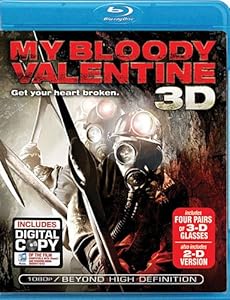
Bad Movie Review: My Bloody Valentine 3D

I've gotten a bit soft on remakes over the years, especially when it comes to horror film remakes. While there are many films that one can be argue should never be remade (Casablanca and Willy Wonka and the Chocolate Factory come to mind), there are a lot of films out there that had good premises or even screenplays, but suffered from minuscule budgets or shoddy productions values. Many of the films we consider "classic" usually obtain that exalted status based on our emotional attachment to the movie rather than the quality of the film.

With that in mind, and despite ignoring any comparison with the original film, My Bloody Valentine in 3D is truly an awful picture. One of the first horror films to jump on the now obnoxiously popular 3D bandwagon, MBV3D is exactly the kind of film that gives horror films a bad name. Ignoring the chance to take an older horror film and effectively update it for a newer audience, the people behind this remake simply threw together as much three-dimensional violence they could get away with under an R-rating and cobbled a script together that barely justifies the illusion of a plot to take us from one murder scene to the next. Horror films don't have to be brilliant works of storytelling in order to be enjoyed, but the occasional semblance of logic wouldn't hurt, either.


Case in point: The initial idea of a bunch of miners being trapped in a tunnel collapse, and then one of them killing all of the others to conserve all of the oxygen for himself, is not wholly far fetched or fantastic. Taking it one step further and having the homicidal survivor mentally snap and run around in full miner's gear killing everyone he comes across with a pick axe is also quite credible. The filmmakers could have even taken the psychosis of the killer to the next level, insinuating that his fear of death has driven him to believe that every living soul he comes across is yet another threat to his life as long as they are still breathing his precious oxygen.

But, just because this traumatic event occurred on Valentin's Day, our demented killer is instead somehow motivated to cut the hearts out of his victims, place them in heart-shaped candy boxes, and leave behind notes that read "Be Mine 4 Ever?" There isn't even a back story involving a bitter love affair or an unfaithful wife leaving him the day of the accident to make this drastic connection between the two completely separate events even somewhat plausible. Just to add frustration to the confusion, why go through the trouble of having him leave notes behind with the clever word play involving Mine, bother to show him using the number 4 instead of spelling it out, but then having the tragic event happen in Mine Shaft 5, and not Mine Shaft 4? I'm willing to put up with flying pick axes that defy the laws of physics, but at least give me a plot-line that doesn't stretch the boundaries of common sense.

It is little things like this that add insult to the injuries left behind by bad movies such as this. The acting is more than acceptable considering the kind of film it is, the editing and camera work are commendable, and even the mind-bendingly lengthy nude scene during the film's opening act is just gratuitous enough to serve its purpose. But subjecting your audience to twisted and uninspiring plot logic that is as predictable as it is incomprehensible does little more than give them a headache, and that is inexcusable no matter what genre your film belongs to.

Reblog this post [with Zemanta]

Tuesday, March 30, 2010

Raymond Chandler on the Oscars

Seven by ChandlerImage by marctonysmith via Flickr
As blunt and eloquent as ever, Raymond Chandler, who was a harsh and outspoken critic of Hollywood, weighed in on the Academy Awards after attending the awards ceremony for the first and last time in 1941:

If you can get past those awful idiot faces on the bleachers outside the theater without a sense of the collapse of human intelligence, and if you can go out into the night and see half the police force of Los Angeles gathered to protect the golden ones from the mob in the free seats, but not from the awful moaning sound they give out, like destiny whistling through a hollow shell; if you can do these things and still feel the next morning that the picture business is worth the attention of one single, intelligent, artistic mind, then in the picture business you certainly belong because this sort of vulgarity, the very vulgarity from which the Oscars are made, is the inevitable price that Hollywood exacts from each of its serfs.

Reblog this post [with Zemanta]

Monday, March 22, 2010

Bad Movie Review: Surrogates

Surrogates (film)Image via Wikipedia
Surrogates falls into that category of films that end up being much better than anticipated. Films that do not screen themselves for critics ahead of the release date are usually predestined clunkers, as not wanting a write-up in the Friday papers is a red flag that the distributors are almost certain that the weekend box-office is the only shot they have of recouping costs before word of mouth kills the film. Expecting the worst, Surrogates manages to surprise with a decent story and great performances, even if this welcome deviation from the norm only manages to set the viewer up for a different fall.

The opening, of Surrogates, featuring a series of news clips marking the advancement of technology over the years, is an immediate red flag. Films that feel the need to dump a mini history lesson on the audience in the very beginning are usually the product of screenwriters or filmmakers that are either too lazy to explain the film’s setting through natural exposition, or severely underestimate the intelligence of the audience. This is the reason, for example, that Iron Man starts with a brief comedy/action scene transplanted from the middle of the film: to camouflage the Tony Stark Bio Montage as a transitional scene, rather than a quick info-dump.

However, in the case of Surrogates, this crash-course to avoid answering question throughout the film actually works to the film’s advantage. In the world of Surrogates, neurologically linked prosthetics have advanced to the point that remotely controlled full robotic automatons are commonplace. Originally intended to allow the paralyzed and handicapped to function normally in the world, Surrogates are instead used by a vast majority of the population, who sit at home in docking stations while indestructible versions of themselves take their places in the real world.

What is most surprising about the film is that it actually touches on the many themes for which type of scenario has the potential, more so than you would expect. Surrogates never fully resemble their users , but instead take on the role of either idealized self-images (younger, more attractive) or starkly contrasting fantasy personae (men masquerading as women, white and nerdy scientists as seven foot tall black men). Personal identity, public role-playing, self-hating attitudes and vanity run amok are just a few of the sociological viewpoints under examination here.

Then there is Bruce Willis’ character, a federal agent with a growing uneasiness towards Surrogate usage, fueled by his slowly crumbling marriage. Ever since a car accident that killed their only son, the still-mourning couple now interacts almost exclusively through their surrogates, demonstrating not only the emotional impact that such a tragedy can have on a couple, but the alienation that comes with human interaction through technology. This is complicated even more by Willis’ wife, played by Rosamund Pike, whose accident-scarred face is tragic reminder of her son’s death, one that she can only escape by living a new life in an artificial body. Even an advertisement for new surrogates for children raises even more issues: when it comes to the safety of your child, where do you draw the line between protection and isolation.

With this much depth going for it, you would think that the film would weigh anchor and build a story around these themes. Unfortunately, this is where the film ultimately fails, and where it all falls short: the apparent need by the studio for the film to fall into traditional action/sci-fi conventions. Ever since Terminator 2, any film involving robots invariably involves chases with super-strong/agile robots leaping around and shrugging off insane amounts of damage. Surrogates could have easily sustained several action sequences without resorting to robots throwing parking meters like javelins and wirework leaping effects straight out of Crouching Tiger, Hidden Dragon.

This need to transform the future to such an extreme level leads to several illogical and convoluted premises. First, there is the extreme implication that ninety-nine percent of the world now uses surrogates; home computers and iPods aren’t even that popular, and it is seriously debatable if they would be even if they were free, which Surrogates definitely aren’t. Then, just to draw a sharper contrast, the film reasons that in such a world, those who refuse to use surrogates would end up living in homeless shanty-towns designated as Technology-Free Zones where shooting at federal agents and publicly burning dead bodies are acceptable under their own independent laws. The film then examines the religious implications behind surrogates long enough to make the anti-surrogate movement seem like a cult (complete with wild-haired Ving Rhames spiritual leader), yet not long enough to explain why the Vatican hasn’t led a holy crusade against soulless automatons that apparently enable risk and guilt-free sex for their home-bound users.

Surrogates is indeed far better than expected, but that doesn’t make up for falling short of its potential. Instead of taking the premise into new directions that few features seem willing to confront, the film instead forces itself into the predetermined molds cast from studio sci-fi films of the past. Shooting for a strange hybrid of They Live, The Matrix and I, Robot invariably ensures a swing and a miss, especially with an ending reminiscent of Escape from LA pasted on like a happy little bow. This is not to say that it isn’t worth watching. Just be prepared to be equally surprised and disappointed.

Reblog this post [with Zemanta]